
Retro Re-release Roundup, week of August 20, 2026
Dawn of Dark Defenders.
I'm more than happy to apologize for the delay in this week's roundup, but I will never apologize for drafting directly into the CMS. Inefficiency 'til death.
ARCADE ARCHIVES / ARCADE ARCHIVES 2
Cyber Cycles
- Platform: Nintendo Switch 2, PlayStation 5, Xbox Series S/X (worldwide, ACA2) / Nintendo Switch, PlayStation 4 (worldwide, ACA)
- Price: $17.99 / €14.99 / £11.99 (ACA2), $14.99 / €14.99 / £11.99 (ACA), $2.99 / €2.99 / £2.49 (ACA-to-ACA2 upgrade)
- Publisher: Hamster / Bandai-Namco
What's this? An ever-so-slightly-sci-fi motorcycle racing game, originally developed by Namco and distributed in arcade via deluxe ride-on cabinets in 1995 and never reissued or adapted for home consoles until now; players select from one of multiple futuristic motorcycles, each offering different handling and performance, and race from checkpoint to checkpoint around either the relatively sedate Green Hill course or the more complex Neo Yokohama course. (As is customary for these more complex 3D reissues, local split-screen multiplayer functionality is exclusive to the ACA2 version, with the standard ACA release being restricted to solo play.)
Why should I care? You've made your peace with many of these never-ported early-3D Namco games being spectacle-first and content-second, and that using a pad to control a game designed to be steered by straddling a big pretend motorbike is not going to capture the truest essence of the intended experience. Either way, the music's bangin'.
Helpful tip: The instructions are a little unwieldy to reproduce here, but there are two secret vehicles (including a nigh-broken penguin on a mped) that can be accessed via a string of button inputs that are listed in the digital manual.
Ninja Emaki
- Platform: Nintendo Switch 2, PlayStation 5, Xbox, PC via Xbox Play Anywhere (worldwide, ACA2)
- Price: $9.99 / €8.99 / £7.39 (ACA2), $2.99 / €2.99 / £2.49 (ACA-to-ACA2 upgrade)
- Publisher: Hamster / Nichibutsu
CONSOLE ARCHIVES
Little Princess: Marl Oukoku no Ningyouhime 2 (aka Rhapsody II: Ballad of the Little Princess, PlayStation)
- Platform: Nintendo Switch 2, PlayStation 5 (worldwide)
- Price: $11.99 / €10.99 / £9.89
- Publisher: Hamster / Nippon Ichi
What's this? The 1999 sequel to Nippon Ichi's musical fantasy RPG Rhapsody, originally developed and pubished for Sony PlayStation exclusively in Japan in 1999, with an emulated PS Classics reissue for PlayStation 3 and PlayStation Portable in 2007 and a globally-published, localized remaster released in 2023, both as a standalone PC game and as part of the Switch/PS4 Rhapsody: Marl Kingdom Chronicles two-pack; players lead the daughter of the first game's heroine on an adventure with curious parallels to the one experienced by her mother, with battles that eschew the quasi-tactical system from the first game in favor of more conventional turn-based combat. (Once again, this Console Archives release is listed on international storefronts with the modern localized title but is in fact the raw, untranslated original.)
lWhy should I care? You played the original and want to experience more of the whimsy with just a fraction more bite, and you feel compelled to specifically buy this CSA reissue because you already bought the first game via CSA and require consistency, irrespective of whether you can or can't enjoy it in Japanese.
Helpful tip: While it doesn't end on a cliffhanger as such, this game is very much the first half of an experience that was concluded with the PS2 sequel, hence why the two games were remastered as a double-pack.
EGG CONSOLE
The Legend of Heroes III: White Witch Renewal (PC98)
- Platform: Nintendo Switch (worldwide)
- Price: $7.19 / ¥990
- Publisher: D4 Enterprise / Nihon Falcom
What's this? The third game in Falcom's narrative-driven Dragon Slayer RPG sub-series The Legend of Heroes and the first to ditch the Dragon Slayer moniker, originally developed and distributed for PC98 computers in 1995 in a few different configurations (including the later Renewal revision presented here), with distinct outsourced remakes produced by two separate studios for Sega Saturn and PlayStation in 1997 and 1998, a Falcom-made remake for Windows in 1999 and yet another outsourced remake for PlayStation Portable in 2004, which saw a North American release under the title The Legend of Heroes II: Prophecy of the Moonlight Witch (with the numbering falling victim to certain PSP remakes being localized out of chronological sequence). The first game in the so-called "Garghav Trilogy", this game sees the player guiding the dual protagonists on a coming-of-age ritual that unfolds into an adventure of cataclysmic proportions, with heavily automated turn-based combat that primarily requires the player to switch out and assign preset routines for each party member.
Why should I care? While the legacy of these games has been reduced to a footnote in the history of the globally renowned sub-sub-series Trails in the Sky, this particular subset of The Legend of Heroes games were the first to find any sort of global footing and were the first ones to really hone in on the series' identity — that is, the prioritization of dialog and narrative over all else — so one might be interested both as a historical curiosity and also as a reference point when A/B'ing with any one of the remakes, which all took great liberties with the combat in particular.
Language barrier? Absolutely, and a general "how much do I feel like reading today?"-based stamina barrier to boot.
G-MODE ARCHIVES+
- Platform: PC via Steam (worldwide)
- Price: $12.99
- Publisher: G-MODE / Hopemoon
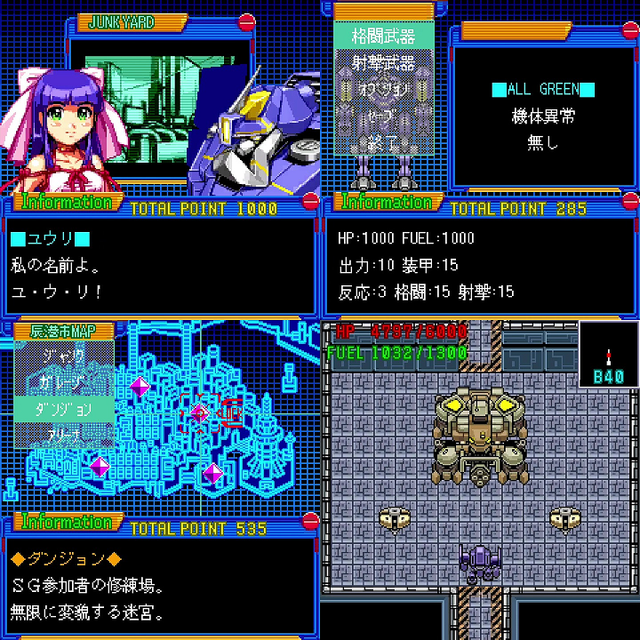
What's this? An overhead, roguelike-esque mecha combat RPG, originally developed by Hopemoon and distributed for Japanese feature phones by Nihon Enterprise in 2005. Set in a futuristic slum, the player controls a mecha on a quest to bring fortune to a young girl who found and resurrected the mecha from a junkyard, which can be achieved by fighting through randomised dungeons in order to acquire currency and upgrades and eventually defeating all 30 rival combatants at the "Strike Arena" tournament.
Why should I care? I can't tell ya whether it's fun to play but it has the same writer as other recently-reissued Hopemoon games, so my assumption is that it's at least fun to read (provided you can read it, of course).
Helpful tip: G-MODE's choice of capsule/thumbnail art was a litte suspect, to put it mildly, so rather than repeat the mistake of a direct embed, I'll instead link to it behind this here text.
PLAYSTATION PREMIUM
August '26 update: Atlantis: The Lost Empire (PlayStation), Onimusha: Dawn of Dreams (PlayStation 2)

What're these? The Eurocom-developed 3D action-adventure tie-in to Disney's famously underperforming 2001 animated feature Atlantis: The Lost Empire, and the fourth mainline title in Capcom's samurai-horror series Onimusha, originally developed and published for PlayStation 2 in 2006 and representing something of a shift from the game's Resident Evil-esque roots in a less horrific direction, and one further informed by some of the more bombastic 3D melee action games of the day.
Why should I care? I've never gone hands-on with Atlantis but it surely looks better than most PlayStation games of its ilk, and I'm willing to take it on faith that Eurocom delivered a better-than-average experience, as was their tendency. As for Dawn of Dreams, while it seems to be remembered for supposedly killing the franchise, my suspicion is that the series simply wasn't ever going to sustain its appeal for so long, and that the abundance of somewhat technical, combat-forward content now serves as a refreshing time capsule to trends in action game design that have been largely abandoned in favor of... well, try that new Onimusha reboot game next month and see for yourself. (A word of advice: Dawn of Dreams was one of a few mid-'00s Capcom games whose balance was ruined during localization at the behest of producers taking feedback from the wrong online communities, so if you'd like to try the game with its intended balance, set your system language to Japanese — that'll let you access the Japanese build, which offers full English text and voice settings, and by save-stating on the title screen, you can continue to play the Japanese version from that save state even after reverting your system language.)
Standalone availability: You should be able to buy either game for the equivalent of $10, or $5 if you're a PS+ subscriber.
OTHER
Dark Castle & Beyond Dark Castle
- Platform: PC via Steam (worldwide)
- Price: $9.99 or equivalent (each), $14.99 or equivalent (bundle)
- Publisher: Ludit
What're these? Reissues of the original versions of Silicon Beach Studios' Macintosh puzzle-platformers Dark Castle and Beyond Dark Castle, originally released in 1986 and 1987, respectively, and ported with varying degrees of colorization across most of the computers of the day, as well as the Sega Genesis and Philips CD-i; these versions are being reproduced via the Indigo Runtime Mac OS wrapper and are essentially presented as-is.
Why should I care? You want to experience two games that not only demonstrate some of the more artful applications of greyscale visuals from the early Mac era, but also represent a nexus of sorts between the ever-so-slightly-mean-spirited adventure game humor of the day and the exactitude that came to define the subgenre now know as "cinematic platformers".
Helpful tip: These releases are intended to set the table for a fully-fledged Dark Castle revival, and were preceded by a Steam reissue of the creators' first revival title, 2008's Return to Dark Castle, which I neglected to report because I had no idea it existed.
Defender of the Crown: The Legend Returns
- Platform: PlayStation 5, Nintendo Switch, Xbox, PC via Steam (worldwide)
- Price: $19.99 or equivalent
- Publisher: Nordcurrent
What's this? A remake of Cinemaware's Amiga-selling 1986 strategy-with-nominally-interactive-cinematics game Defender of the Crown, which saw ports and conversions for every computer under the son, as well as NES, Philips CD-i, Atari Jaguar and, later, Game Boy Advance and smartphones; this remake purports to offer a "retro" mode that conforms to the audiovisuals of the Amiga original with the expanded mechanics of later conversions, a "classic" mode that presents overhauled system mechanics and an all-new "kingdoms" mode that reshapes the game into a deckbuilding roguelite.
Why should I care? You're specifically interested in playing the roguelite mode, which seems to be perfectly fine for what it is, and not either of the conventional modes, which by early reports are inaccurate at best and clearly broken at worst.
Helpful tip: I have seen some accusations against this game for using generative-AI visuals that, to my knowledge, are not based in fact, so I'd like to implore people to not use "AI" as a synonym for "visuals I don't care for": yes, AI is bad, but not everything bad is AI, and inaccurate diagnoses only make the fight against gen-AI visuals more difficult, so please, come correct.
- Platform: Xbox, PC via Steam (worldwide), PlayStation 5, PlayStation 4, Nintendo Switch 2, Nintendo Switch (worldwide)
- Price: $59.99 or equivalent
- Publisher: 5pb./MAGES / Spike-Chunsoft
What's this? A second remake of 5pb. and Nitroplus' hit sci-fi visual novel Steins;Gate, which was originally released for Xbox 360 and PC in Japan in 2009 and eventually released worldwide via PlayStation 3, PlayStation Vita and Steam released that were localized from 2014 to 2015; the game also spawned several mixed-media projects including a successful TV anime, from which the 2019 remake Steins;Gate Elite derived most of its source visuals. For this remake, MAGES turned to emulation company M2's "E-mote" portrait animation tool to recreate the game with 3D visuals, updated character designs, re-recorded Japanese voice performances and music and an additional route that may or may not be new to fans of the broader Steins;gate media world.
Why should I care? There seems to be an understanding among fans that MAGES is on their last legs and is returning to the well with yet another Steins;Gate remake out of desperation, so one may choose to put aside their distate with the new visuals, lack of new compelling content and alleged significant truncation of the script in order to prop up the company for long enough to make a genuine successor game.. or maybe you just like how it looks, iunno.
Helpful tip: Just as Elite came with a Famicom-style companion game (or, more accurately, a companion game developed to genuine Famicom spec), Reboot is being packaged with a localization of a Japanese PC-style adventure side game as an early-purchase bonus; it'll be bundled with first-run physical Sony/Nintendo copies and distributed to digital PC/Xbox players who buy before November 1.
UPDATES UPDATES UPDATES
Super Bomberman Collection (PlayStation 5, Nintendo Switch 2, Nintendo Switch, Xbox, PC via Steam) update: Panic Bomber W
Coming in tandem with the long-in-the-works physical edition of the well-received Super Bomberman Collection is this free update, which adds the Super Famicom version of the falling-block puzzle game Panic Bomber as an additional playable title. From arcades to Super Famicom to Virtual Boy to PSP, Hudson really thought they were onto something with this particular game, and perhaps today's audiences will find a love for it that wasn't evident in decades prior. (That aforementioned physical release, which was initially scheduled for next week, has been further delayed to late September in most of the world.)