
The Master System Directory: (Cy-Da)
The Cy-Da house rules: You have to write about Master System games.
The Cyber Shinobi (1991)
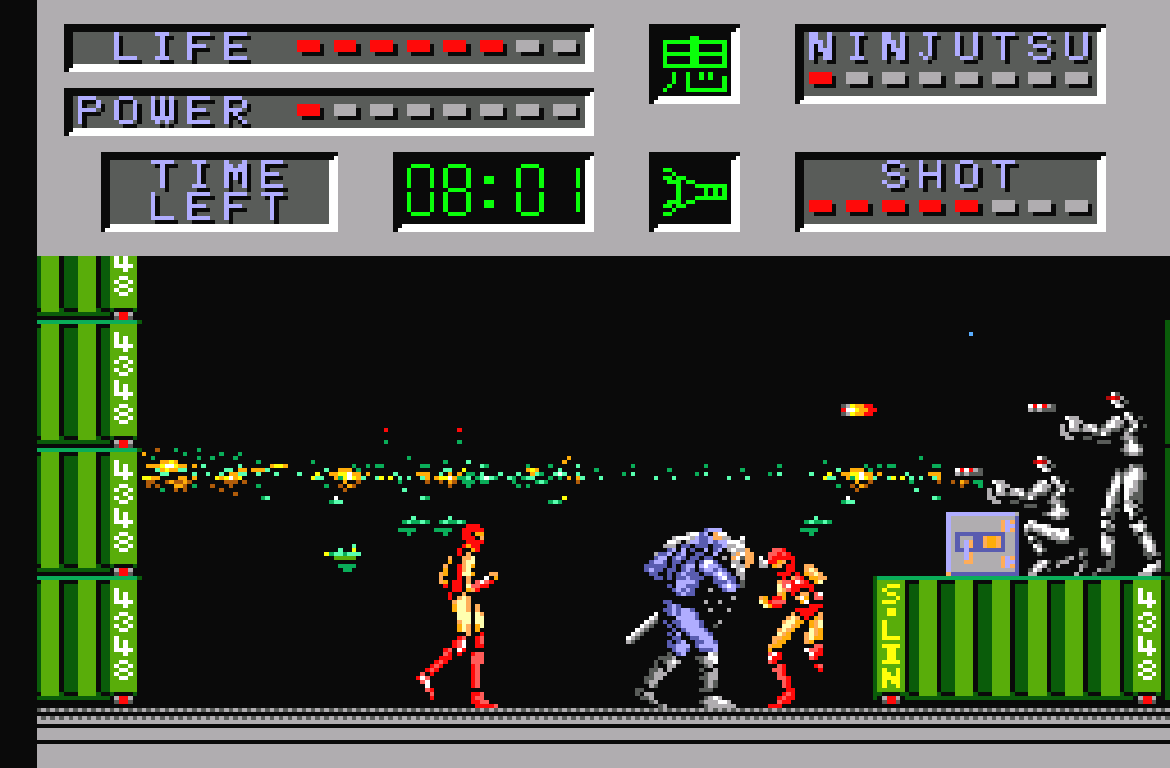
Oh dear, I wasn’t looking forward to this one. The Cyber Shinobi is – to put it politely – an appalling pile of old shit. I wouldn’t mind it so much, I suppose, if it wasn’t positioned as the direct sequel to the Master System conversion of the original Shinobi, which is absolutely brilliant and the polar opposite of its cyber cousin. Honestly, I get all conspiracy theory about it, because I find it so utterly difficult to believe that this absolute rubbish was made by Sega themselves. It plays like a Spectrum game in every aspect from movement to level design, with collision detection so sloppy that you can hit enemies even though your sword swings clearly didn’t touch them. At least it’s in your favour, I suppose. Less charming is the game’s tendency to drop the ground away from you without warning, often in a position where your leap to safety will be arrested by an enemy bullet in flight. It’s very unfair and very frustrating, not to mention tedious. I’ve seen some people praise this game’s graphics and… no, just no. Okay, the sprites are larger, but the pixel art is indistinct and amateurish. Married with poor, juddery scrolling and movement, this makes for a very ugly and very bad game. I’ve certainly played worse, but saying “hey, here’s the follow-up to one of the Master System’s best games” and then offering this piffle is nothing more than insulting. The music is alright. That’s the best I can offer. *
Cyborg Hunter (1988)
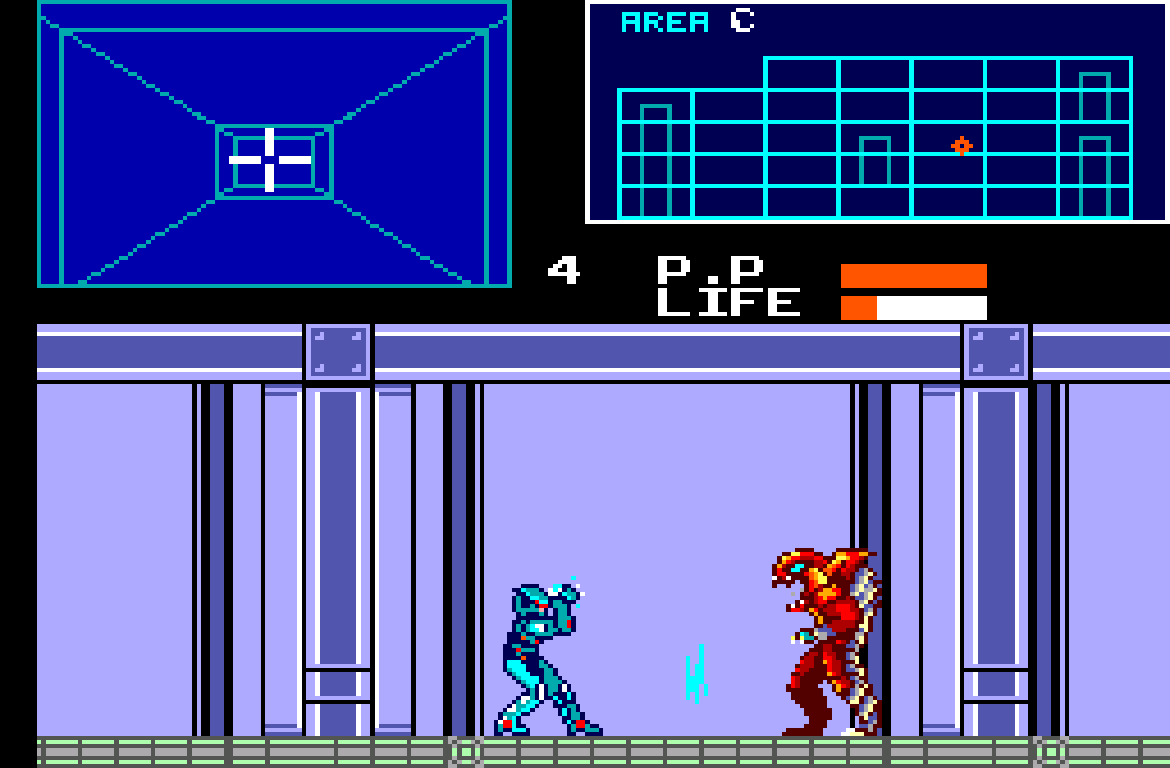
This was released for Sega Mark III as Chouon Senshi Borgman, but shorn of its anime tie-in status for this localisation. I struggled with this one – it’s a sort of Metroidvania type thing which offers smooth action and generally cool aesthetics, but trips up on the coherence front. The controls can be very awkward – you press “Up” to interact with things like elevators, but the same button press drops a bomb if you’re carrying one, making it very easy to waste weapons by standing in ever-so-slightly the wrong place before you try to hit a switch. Why isn’t it “Down” to drop a bomb? You drop them on the ground! The ground is down! Down! Ahem. Well, anyway, that’s not the only issue here. In a completely bizarre swerve, inventory management requires the use of a second controller, which is kind of cool in a way as it sort of conjures up the idea of, well, being a cyborg and having to manipulate different functions of your technology, swapping between controllers like you’re sat at the array of a futuristic robot. No? Okay, it’s really kind of irritating, especially given that you drop bombs by pressing up even though the developers were clearly willing to let you use extra buttons on a different controller. I know I’m harping on about this one thing a lot but really is cataclysmically stupid. I also managed to get into a situation early on wherein I entered the wrong door and was immediately, apparently, soft-locked – unable to progress without a particular item and unable to leave the room again. I’m unsure if this was the game being incredibly fussy about where I needed to stand, or if it’s just that untidy in its design. Of course, in attempting to leave the room, I managed to drop (and waste) my only remaining bomb. It’s possible that this game has more to offer than I was able to experience of it, but I just wasn’t inspired to persevere. Some cool stuff, but fussy to the point of real irritation. **
Daffy Duck in Hollywood (1994)
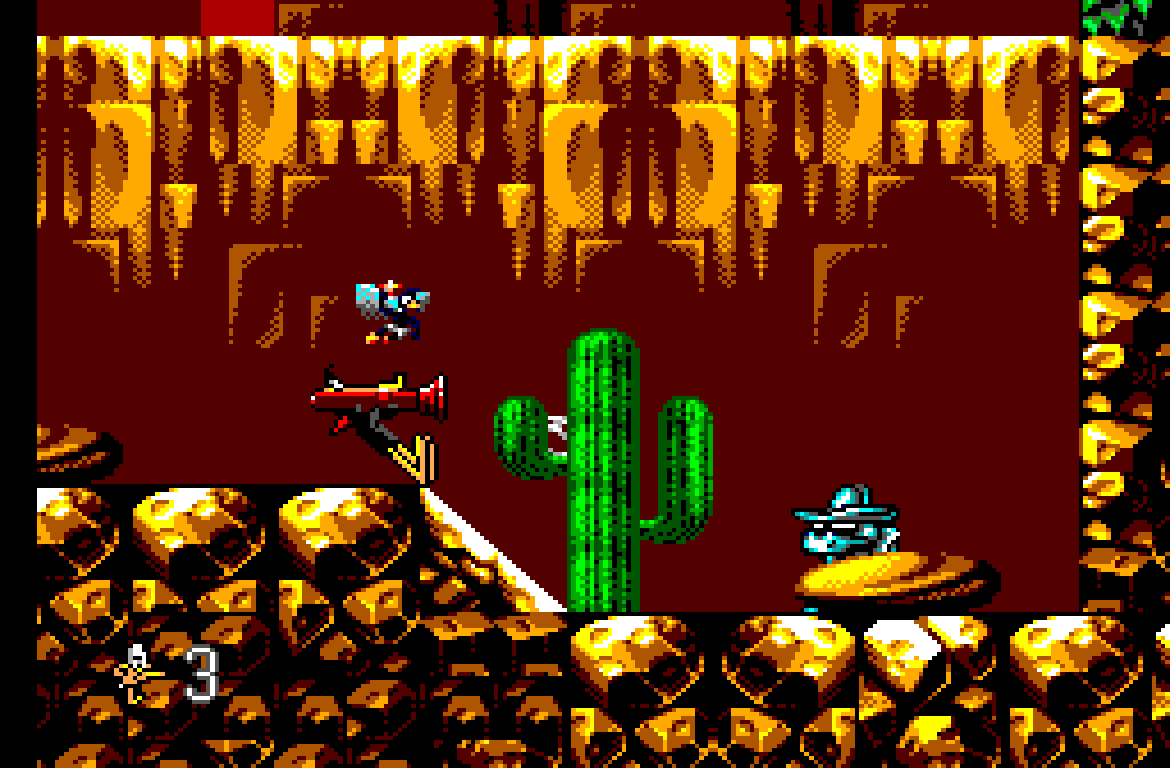
This is a polished, playable little platform game that looks absolutely superb, but falls a little short in the gameplay stakes. You may enjoy it more than I did, but – honestly? This is exactly the kind of game I tend to like more than most, so you probably won’t. Taking control of Daffy Duck, you’ve got to run, jump and bubble-blow (?) your way through a bunch of archetypal Hollywood movie stages. The controls are reasonably tight, with Daffy able to leap up and cling to the bottom of certain platforms. It’s all quite well put together, but a couple of decisions lessen the fun. First, there’s the way each stage is gated in numerous places, requiring you to capture each enemy in a section with your bubble gun in order to proceed. This isn’t exactly a stressful experience, but it does lead to a loss of forward momentum. Most of the game’s collectables are also initially invisible, only appearing when Daffy hits certain also-invisible trigger points. You could just ignore them, sure, but in practice this means you’ll be moving through an area only to have to wait a few seconds and backtrack to grab something. I mean, it’s fine, really. Just a tiny bit more irritating than if the collectables were just… there already. I find myself wondering if this is a way to prevent sprite flickering by keeping the screens relatively uncluttered. If so, that’s actually quite smart, but it doesn’t have a positive effect on my experience. I feel like I’m being a little harsh on a game that’s rather impressive in its feel and presentation, especially because I rather liked it on Game Gear. On Master System, the platforming competition is a little stronger, so Daffy Duck in Hollywood does lose a few points. It’s a bit of a classic on handheld, but I don’t dig on it quite so much here. ***
Danan: The Jungle Fighter (1991)
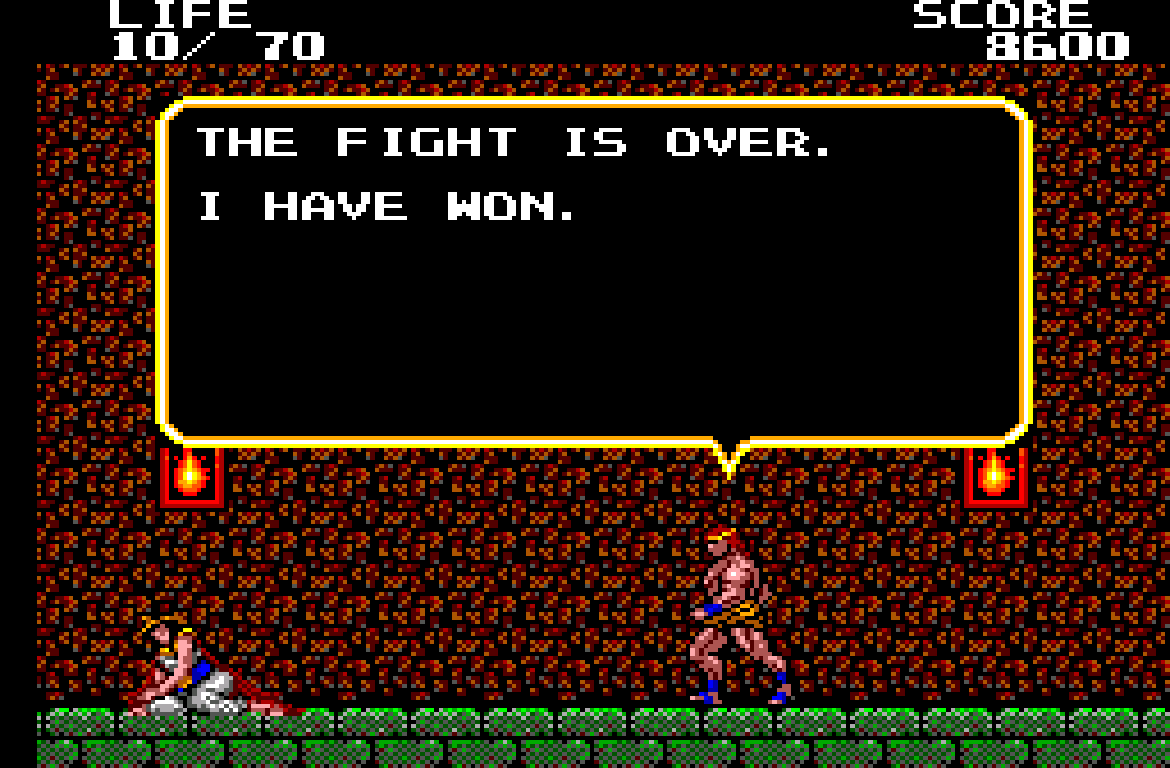
I’ve got to do this. I’ve got to get it out of the way. Sorry. Okay, here goes: Mmm, Danan. I don’t even know if Americans know what that’s a reference to. What a waste of time. Moving swiftly on, Danan: The Jungle Fighter is about a man named Danan who fights in jungles. Danan’s a fantastic man! This utterly bizarre game is something of a cross between Wonder Boy in Monster Land, Tarzan and a fever dream. I checked to see if this one was based on a manga or something and no, it’s an original concept that is utterly incomprehensible and I sort of love it for that. You’ll find yourself skipping through reams and badly-translated text here, as Danan embarks on his quest to prevent the resurrection of Gilbas. Who or what is Gilbas? Goodness knows. At any rate, it makes for a rather fun game, though the level design is entertainingly sloppy; many areas contain alternate paths which leads to items, though these don’t seem to account for how tall Danan is nor how high he can jump, meaning almost everything can be collected without dealing with any of the obstacles at all. Also somewhat annoying is Danan’s weapon, a knife with remarkably short range, though this isn’t much of a big deal when it comes to dealing with the enemies. Everything’s well-drawn, with great backgrounds and quite frankly a banging title screen. Stages are linear, but there are plenty of doors to enter in order to scavenge interior sections for items, as well as ladders leading to underground caves. In the end, though, you’ll always make your way to the boss, figure out their deal quite rapidly and dash through to the next stage. It’s all rather easy, but the crazy story adds a lot of appeal and its shortcomings in level design can be forgiven due to the breeziness of it all. ***
(Next: De)