
Retro Re-release Roundup, week of August 6, 2026
The Virtual Boy requiem draws to a close.
Allow me to present you with a potential respite with the atypically Japanese-language-heavy contents of this week's roundup: the digital PC and console release of Changeable Guardian Estique, a homebrew NES/Famicom shooting game developed by veterans from Compile, Westone, Namco and M2 that was released on authentic cartridge a little while back, and is every bit as impressive a NES game as the recent Earthion was for Genesis/Mega Drive. (Play on God of Game mode!)
ARCADE ARCHIVES / ARCADE ARCHIVES 2
Combat School (Boot Camp)
- Platform: Nintendo Switch 2, PlayStation 5, Xbox Series S/X (worldwide, ACA2) / Nintendo Switch, PlayStation 4 (worldwide, ACA)
- Price: $9.99 / €8.99 / £7.39 (ACA2), $7.99 / €6.99 / £6.29 (ACA), $2.99 / €2.99 / £2.49 (ACA-to-ACA2 upgrade)
- Publisher: Hamster / Konami
What's this? An assemblage of military training-style minigames, originally developed and distributed in arcades (sometimes under the title Boot Camp) by Konami in 1987, with contemporaneous conversions for MS-DOS and a variety of European microcomputers; players face off against either a CPU opponent or another player across a large handful of training exercises, some armed and some not, whose victory conditions are generally dictated by either button-mashing or timing challenges, with a surprise awaiting the overall victor... (For whatever reason, this release exclusively contains the Japanese Combat School ROM; the voice clips are the only substantial difference, but the English voice clips will certainly be missed.)
Why should I care? You want to see if two great late-'80s Konami tastes (Track & Field, military action) taste great together, you're a sucker for a twist ending, or you grew up with one of the computer conversions and want to see how this game played as intended, rather than with the requirement that you break your joystick to progress.
Helpful tip: This game originally shipped with both trackball and joystick control panels; this reissue lets you mimic the trackball via USB trackball/mouse and/or Switch 2 joycon mouse functionality (ACA2-only) but, unlike other recent trackball-compatible ACA releases, the original trackball implementation was relatively perfunctory and not something one should necessarily go out of their way to recapture.
CONSOLE ARCHIVES
UFO -A day in the life- (PlayStation)
- Platform: Nintendo Switch 2, PlayStation 5 (worldwide)
- Price: $11.99 / €10.99 / £9.89
- Publisher: Hamster / Sunsoft
What's this? An adventure game of sorts, originally developed for Sony PlayStation by Love-de-lic and published exclusively in Japan by ASCII in 1999, and never reissued before now. Players control the envoy of an alien rescue party sent to retrieve the 50 or so aliens that have gone missing after their ship crashed into a human apartment building; the missing aliens are invisible to the player, so one visit and revisit the various locales within the building at different times, observe the routines and behaviors of the building's denizens and learn the habits of each species of missing alien in order to uncover them using a camera-esque analysis device. (Reminder: Hamster's not in the business of game localization, so this one's coming to ya raw.)
Why should I care? Y'know MOON: Remix RPG Adventure, the once-removed inspiration for Undertale and mainstay of Japan-only-hidden-gem PlayStation lists for decades until its long-awaited localized remaster a few years back? This is the second game by that studio, specifically helmed by the folk who'd later run point on various Paper Mario games and the Tingle games for Nintendo DS, and it offers a lot of the same charmingly offbeat characters and animation, dark humor and genre nonconformity as its predecessor, albeit with far less of the cruft that came with nominally pretending to be an RPG, and I do think UFO might ultimately be the most approachable game in the Love-de-lic trilogy... so, yeah, it's a shame it's not being translated, but perhaps any excitement generated by this reissue will be enough to set things in motion — a lot of Japanese folk didn't think they'd ever see the Japanese version again, but here we are.
Language barrier? The overabuntant animation and staging is such that I do think one could intuit quite a bit of the game via visuals alone, but I don't know that it'd be all that much fun if you're unable to read any of the dialog.
EGG CONSOLE
Elthlead (PC88)
- Platform: Nintendo Switch (worldwide)
- Price: $6.49 / ¥990
- Publisher: D4 Enterprise / NCS / Extreme
What's this? A fantasy-themed war simulation game, originally developed and published by NCS for PC88 and MSX2 from 1987 and remade in the engine of its sequel for both PC-98 and X68000 a couple years later; players take on the forces of darkness via turn-based hex-grid tactical battles consisting of both grouped units and unique units with magic or other special abilities, with battles initiated under the umbrella of a high-level strategy layer that sees one liberating and fortifying towns on a map.
Why should I care? This game is often cited as both the first-ever "SRPG" and the grandfather of NCS' later and more popular Langrisser series, and while those aren't necessarily untrue statements, I do think they're unhelpful inasmuch as Elthlead probably isn't going to satisfy anyone looking for a genuine strategy-RPG, nor is it crucial or even particularly helpful towards one's fuller appreciation of Langrisser; even so, as a game that both grabs liberally from and heavily streamlines a bunch of gimmicks from Nobunaga no Yabou and Daisenryaku, it does present a relatively accessible take on a certain strain of war sims that tended to be rather unapproachable.
Language barrier? It's more automated than a lot of games of its ilk and many of the basic commands are rendered in English, so someone with a working knowledge of this era of war sims could probably manage without much trouble.
G-MODE ARCHIVES+
- Platform: Nintendo Switch (Japan)
- Price: ¥1500
- Publisher: G-MODE / Hopemoon
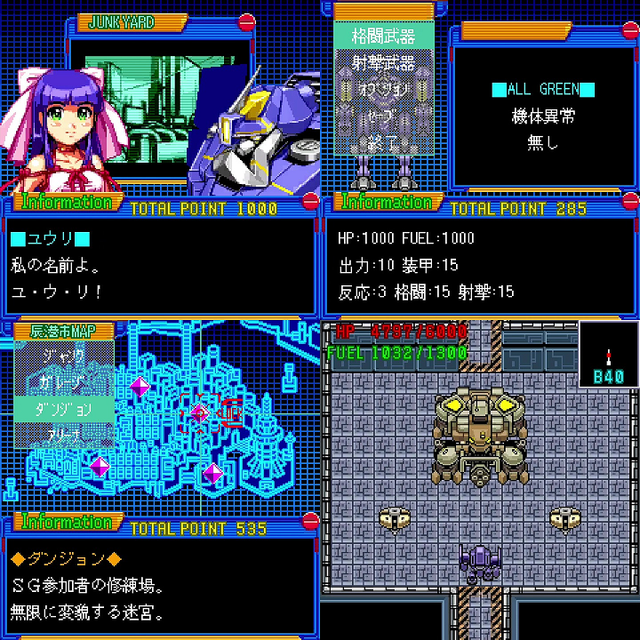
What's this? An overhead, roguelike-esque mecha combat RPG, originally developed by Hopemoon and distributed for Japanese feature phones by Nihon Enterprise in 2005. Set in a futuristic slum, the player controls a mecha on a quest to bring fortune to a young girl who found and resurrected the mecha from a junkyard, which can be achieved by fighting through randomised dungeons in order to acquire currency and upgrades and eventually defeating all 30 rival combatants at the "Strike Arena" tournament. (You can view the trailer here, which is now linked rather than embedded due to a rather dubious thumbnail...)
Why should I care? I can't tell ya whether it's fun to play but it has the same writer as other recently-reissued Hopemoon games, so my assumption is that it's at least fun to read (provided you can read it, of course).
Helpful tip: You'll be able to grab this game on Steam sometime soon, too.
JALECOLLE FAMICOM VER.
- Platform: Nintendo Switch, (worldwide)
- Price: $7.99 or equivalent
- Publisher: City Connection
What's this? An emulated reissue of the European NES and Famicom ports of Jaleco's 1990 fixed-screen arcade action game Rod Land, which was successively converted for NES, Game Boy and the European microcomputers of the day by The Sales Curve from 1990 to 1993, and later ported from Famicom to PlayStation as part of the Japan-only Jaleco Collection vol.1 compilation for PlayStation in 2003; these ports are being presented here with the usual JALECOlle comforts, which include save states, rewind, English subtitles for the Japanese ROM and vice-versa, speedrun modes, achievements, pertinent info in the screen borders, art/package/sound gallerie and more. (The NES version was a later build than the Famicom version and offered more in-game options and so on, so this reissue's being marketed to Japanese players along those lines and doesn't feature any particularly new enhancements.)
Why should I care? Rod Land is a game that was significantly more popular in Europe than elsewhere, and my impression is that most of the lingering fondness for this game was spawned by the various UK-produced home conversions rather than the arcade original, so I imagine this specific reissue is going to tickle a few people even more than the authentic arcade version; one might also choose to compare and contrast the home version with the arcade original and note how the optional "enhancements" might've disrupted the balance of the original (or, to put it another way, games designed with no jumping probably don't need jumping). You might also just be North American and therefore aggrieved that Europe received a NES game that y'all didn't, but I'd like to think you aren't so petty.
Helpful tip: For as much care and forethought went into these conversions back in the day, it's worth acknowledging that they failed to adapt the entire back half of the game, so even those of you who specifically loved these versions might want to grab the original via Arcade Archives.
NINTENDO SWITCH ONLINE EXPANSION PASS
July '26 update: D-Hoppers and Zero Racers (Virtual Boy)
What're these? A pair of games that were advertised but ultimately not released during the brief life of the Virtual Boy: Intelligent System's layer-hopping overhead action-adventure game Dragon Hopper, and a wireframe tunnel racer that's two parts F-Zero and one part "that 3D tank game for Game Boy that never left Japan".
Why should I care? The mere fact that Nintendo's not only acknowledging but allowing people to play these games is noteworthy on its own, but there's also something bittersweet about finally being able to prove the suspicion that these unreleased games were better than most everything that actually released for Virtual Boy in its day — which is not to say they're particularly good, even, but it's nice to know somebody, somewhere was putting in a little effort.
Helpful tip: These games were released alongside the long-promised color customization update, which lets one choose from a wide variety of alternate, non-crimson palettes, including a few that wouldn't be out of place on the NSO Game Boy app.
OTHER
- Platform: Nintendo Switch, PC via Steam (worldwide)
- Price: $29.99 (collection) / $24.99 (Route-16R) / $8.99 (Route-16 Turbo) / $5.99 (Route-16)
- Publisher: Sunsoft
What's this? A collection containing emulated reissues of the original 1981 arcade version of Sunsoft's car-themed maze game Route-16, the 1985 Famicom adaptation Route-16 Turbo and the brand-new Route-16R, an indie revival title developed by Japanese studio Wit One that reimagines the game with multiplayer and Super Robot Wars battles, or somethin'. The arcade game's also available as a standalone on Switch, and Turbo is available standalone on PC, Switch and, for some reason, PlayStation 5; Route-16 is essentially an Arcade Archives release with all the extra modes stripped out, and Turbo is a similarly modest package, save for a bug fix that allows players to see all the later stages that were accidentally rendered inaccessible in the original version.
Why should I care? You're someone who's been waiting for Sunsoft to bring back one of their old games in a format that vaguely resembles the original, instead of trying to turn their lighthearted adventure game into an Overcooked clone or whatever, or you're someone who's willing to give a lot of grace to the arcade original for the simple fact that it's basically running on Space Invaders hardware.
PSA: I suppose I should once again remind people that Sunsoft is part of the same corporate family as Israeli "counter-intelligence" company Cellebrite — the people behind Ufouria 2 are not the same people wiretapping folks on behalf of the NSA, and the latter party is gradually divesting itself and will eventually stop tainting the game business by association, but until that moment, stay vigilant.
Tamani wa Sora o Miagete ("Tama★Sora")
- Platform: Nintendo Switch (Japan)
- Price: ¥1280
- Publisher: Mebius
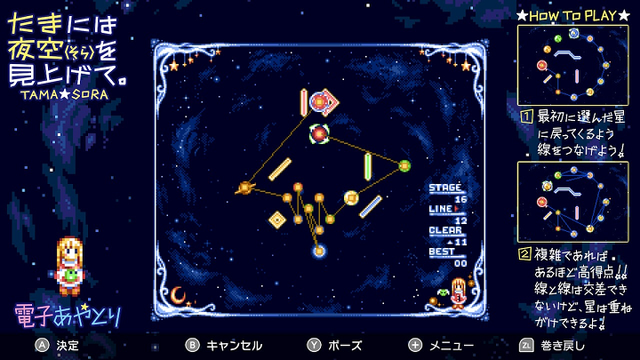
What's this? A puzzle game about forming constellations, loosely modeled after the classic fingers-and-string "cat's cradle" game, originally developed for MSX2 by doujin MSX circle Syntax in 2001 and reissued here in emulated form; aside from basic emulator functionality like save states, this version includes extra information in the screen borders, alongside other unspecified tweaks.
Why should I care? You want to see what the diehards of the MSX scene were up to many, many years after their platform had disappeared from relevance, but before it had become chic to produce new games for "dead" platforms.
Useless fact: Some of the folk behind this game now run the long-established retro game retailer Game Shop 1983.
- Platform: PC via Steam (worldwide)
- Price: $9.99 or equivalent
- Publisher: Zed Two / Ocean / Piko Interactive
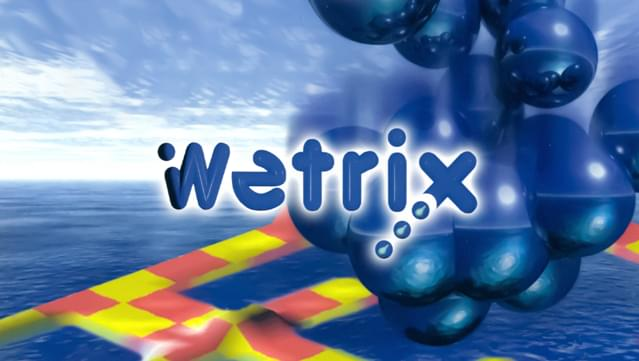
What's this? A reissue of the 1998 3D falling-block dam-builder Wetrix, originally developed for PC and Nintendo 64 by the Pickford brothers' Zed One studio and published by Ocean Software, with later conversions produced for Sega Dreamcast and Game Boy Color; players are tasked with processing the ever-falling tetromino-esque land blocks in order to build walls and recesses in which to contain rainwaterwater without allowing it to drain off the edge off the playfield. (This version, which has arrived on Steam with no fanfare, looks to be a no-frills DOSbox repackage of the vintage PC build.)
Why should I care? You're looking for a game that looks like a '90s screensaver and structurally resembles a zen mobile time-waster but is quietly maddening, and you have more faith than the author that Piko hasn't somehow screwed it up.
Helpful tip: Y'ever play, or notice while walking past a bargain bin, the PlayStation 2 launch-era game Aqua Aqua? Well, it's a second Wetrix, but for some reason the publisher didn't think that was a detail worth telling people.